


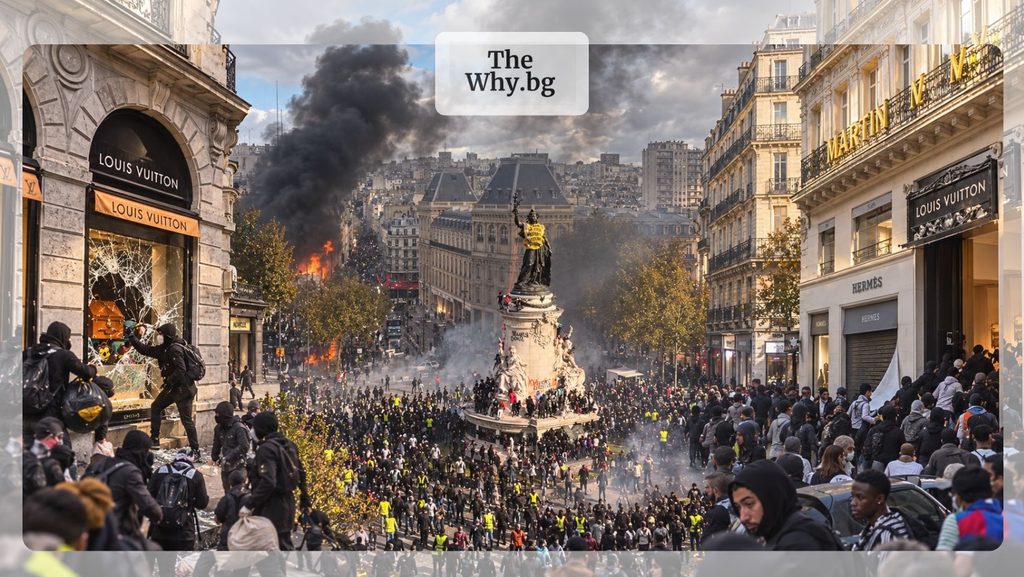
Why demand bread while masked thieves steal Rolex and Hermés: Europe is on the brink of civil war!
Student discontent in France has met anger over the high cost of living. Protests are spreading to other European countries, while groups that smash, set fires and loot are operating alongside the demonstrations. Behind the windows of luxury stores now lies something much bigger: what remains of the social contract when someone else's property becomes booty and a political opponent becomes an enemy?
The bag Hermès does not solve the housing crisis. The stolen Rolex does not lower the price of bread. And a wrecked school does not provide more teachers…
That is precisely why the footage from the French unrest raises a question that cannot be buried under vague talk of social discontent: when does the demand for a better life become a claim on someone else’s life, labor and property?
According to Reuters on October 18 French authorities reported more than 2,000 arrests and over 600 injured police officers following Saturday’s unrest. One demonstrator died after suffering cardiac arrest during a protest in Paris. This is a running, not a final, tally.
Behind these figures lies a conflict that cannot be captured in a single word. There is civil protest. There is political radicalization. There is looting. There is fear. Blurring them together allows some to portray every expression of discontent as a crime, and others to portray every crime as an expression of discontent.
Both distortions are convenient. Both are highly dangerous…
Because the question of whether Europe could move toward civil conflict begins precisely here: can different societies continue to debate their future without depriving those who disagree of the right to security, property and a normal life?
France: they demand better schools, while schools become targets of vandalism
The French student movement began in September with demands for more teachers and better conditions. In its October 8 report, Reuters describes overcrowded classrooms and poorly maintained buildings. The agency also reports a school in Saint-Étienne being devastated and a teacher in Toulouse being struck by a demonstrator. The main demonstration in Paris was largely peaceful.
This is the protest wave’s first major contradiction.
Demanding that the state invest in education is entirely understandable. Destroying educational infrastructure means increasing the bill for the same system from which you are demanding more.
Restoring what has been broken is not a new investment in the future. It is an expense required to return to where you were before the devastation.
And the damage is not limited to windows and equipment. When a school is seen as an acceptable target, the very idea of public property is devalued. “Shared” begins to mean “no one’s,” and “no one’s” begins to mean something you can destroy without personal accountability.
This is not about attributing the perpetrators’ actions to all students. It is about not hiding the perpetrators behind the students.
The cause of education cannot be used as a pretext for destroying it.
Athens: the tent as protest, not the storefront as booty
On October 13, students pitched tents in Syntagma Square in Athens despite the rain. The reason was the housing crisis and the rising cost of higher education, reports Kathimerini.
This action offers a very different image of discontent.
The tent in front of parliament says: “We cannot afford a roof.” It turns the problem into an understandable symbol. There is no need to loot someone else’s store for the message to be sufficiently powerful. That is precisely what makes the Athens example particularly important. It shows the difference between an action that explains a cause and one that buries it beneath its own consequences.
Poverty does not necessarily require violence. Anger does not eliminate the choice of how to behave. And a difficult life does not absolve a person of responsibility for how they treat the lives of others.
Albania: when demands are now directed against the entire government
On October 17, student protests in Tirana continued for a fifth day. Reuters describes discontent over education, job prospects and corruption that has turned into demands for the government’s resignation. There have been attacks on buildings and clashes. Seven police officers have been removed from duty over the alleged disproportionate use of force.
The Albanian case reveals another mechanism of escalation.
The initial dispute concerns a specific problem. Then comes the belief that the problem cannot be solved by the people in power. In the end, the conversation is no longer about a particular solution, but about the government’s right to remain in power.
This is a transition from a social demand to a crisis of political trust.
It is precisely at such a moment that the state’s responsibility becomes twofold: to prosecute violence, but also not to create new grounds for radicalization through illegal actions by its own officials. The rule of law cannot be restored selectively.
The European picture is much broader
France, Greece and Albania do not exhaust the list of protests. But Europe’s map must be read with dates and causes, not as a montage in which every burning street is evidence of the same uprising.
In Spain housing discontent has its own dynamics. On October 8, thousands took to the streets in Madrid following the death of 87-year-old Maricarmen Abascal, who became a symbol of resistance to forced evictions. Reuters also tracked the protest camp in Puerta del Sol square.
In Portugal tens of thousands demonstrated in Lisbon on October 17 against the housing crisis and rising prices. The event was organized by the CGTP trade union confederation, while police did not publish their own estimate of the turnout. Reuters also reported on an earlier tent protest in Porto.
And…
In Italy a protest in Milan on October 17 escalated into clashes, arson and looting. The Associated Press described police intervention and violence alongside a demonstration against wars and the high cost of living. Clashes were also reported in Bologna.
In Belgium hundreds of young people protested in Brussels on the same date against education costs and changes that student organizations say will restrict access to education. A Reuters correspondent observed a car being overturned, while police used tear gas and water cannons.
In Ireland thousands of students demonstrated in Dublin earlier in October for lower fees, funding and affordable accommodation. In Germany there were educational demonstrations in September attended by students, teachers, parents and trade unions. In Austria student organizations are preparing new actions over concerns about university budget cuts. Axios’s October 7 overview distinguishes between events that have taken place and those being prepared.
In Serbia the protest cycle is older and did not stem from the events in France. The German Southeast Europe Association describes nearly two years of student mobilization following the collapse of the station canopy in Novi Sad in November 2024. The demands are for accountability, a fight against corruption and political change.
These are different movements that emerged at different times. Comparing them highlights a common concern: education, housing, incomes and trust in institutions have simultaneously become subjects of sharp social confrontation.
The danger does not require all protesters to have a common organizer. It is enough for different groups to arrive at a similar conviction: that the normal mechanisms no longer work!
How does discontent change the subject?
One student wants a teacher. One university student wants a dormitory. One worker wants their salary to last until the end of the month. One tenant wants not to be pushed out of the city where they live. These demands are not the same. But they can converge around a shared sense of insecurity.
Le Monde describes precisely such a coming together of pupils, students, trade unions and the “yellow vests” for the French demonstrations on October 17. This gives the protest strength, but also creates an internal contradiction. The more different causes it brings together, the harder it becomes to determine who speaks on its behalf and what exactly success would mean.
For some, success means a specific budget decision. For others, a resignation. For still others, a confrontation with the system itself. And for someone who comes to steal, success may simply be measured by what they take away.
A shared street does not mean a shared goal.
This problem is not solely European. On October 16 Reuters reported on protests in Guadalajara, Mexico, triggered by water problems. A different continent, a different immediate cause, and once again a dispute over whether institutions are providing the basic conditions for a normal life.
Why Rolex, Hermès and Celine specifically?
The looted luxury store… There is an obvious discrepancy between the stated need and the item taken.
AFP reported on a looted Hermès boutique in Marseille. The specialist publication WWD covered the attacks on retail outlets, including Celine, and reports of a looted Rolex store.
The choice of luxury goods allows for several explanations. An expensive item may be desired for personal possession. It may be viewed as merchandise for resale. The store itself may be perceived as a symbol of wealth toward which the attacker feels hostility.
These motives are not mutually exclusive. But none of them turns appropriation into social policy!
Even more revealing is the observation by AFP reporters of small masked groups acting in an organized manner during the attacks on stores. This places the case beyond the notion of purely spontaneous, helpless anger. Organized looting must be investigated as organized looting, regardless of what the posters nearby say.
There is also a detail that makes the picture even more absurd: it was not only boutiques that were attacked. According to Carrefour data cited by Reuters, 50 of the chain’s stores were affected, 20 of which were looted.
What public cause are you defending when you turn both the luxury boutique and the neighborhood store into fair game?
Others’ success becomes a source of guilt
There is a principle that does not depend on the size of anyone’s bank account: another person’s property does not become yours because you consider its owner excessively wealthy.
Unlawful enrichment is subject to investigation. Tax rules are subject to political debate. Inequality is subject to analysis. But a smashed shop window is not a judicial decision, and the crowd is not an institution for fair redistribution.
When robbery is justified by the victim’s wealth, social criticism turns into permission to punish someone else’s success.
This is dangerous even for people who have nothing to do with billionaires.
Behind a store are employees, suppliers, repairs, loans and family incomes. Business Insider describes the reactions of affected retailers and the consequences for those working at the attacked outlets. It is easy to say “capital” while looking at the logo. It is harder to explain to the salesperson why their workplace was an acceptable victim of vandalism.
The perpetrators’ educational qualifications and employment status must be established, not invented. But assessing the act itself does not require a degree in sociology. Appropriating someone else’s labor is not labor, and destroying someone else’s well-being does not create one’s own.
The high cost of living is real. So is crime
According to Eurostat, in its October 16 publication, annual inflation in the eurozone in September 2026 reached 3,8%, while energy prices were 18,9% above their level a year earlier. These indicators provide an economic context for the discontent. But a household does not live in a percentage. It lives between a specific salary, a specific rent, a loan and a bill.
Even a slowdown in inflation does not automatically mean a return to previous prices. It may simply mean that the already more expensive cost of living continues to rise, but more slowly.
That is why working people may also have a legitimate reason to protest. The divide is not mechanically between “working people” and “protesters.” It is between civic pressure and appropriation, between demanding a solution and causing new damage.
This distinction also protects the social cause itself. Every riot gives rise to the possibility that the discussion about incomes will be replaced by a discussion about arrests.
Who is behind the mask, and why states owe specific answers
The migration issue cannot be excluded from public debates about security and integration. But for this discussion to be meaningful, it must go beyond reading identities from faces, clothing and headscarves.
A mask conceals identity. A headscarf does not certify refugee status. And citizenship, lawful residence and international protection are different circumstances.
In its October 18 report, Associated Press explicitly noted that French authorities had not linked immigrants as a group to the unrest. Official accusations point to radical far-left groups and people who joined because of the looting. These are the authorities’ versions, which investigations must verify.
The public interest, however, does not end with such a statement.
Verifiable answers are needed: who has been charged, what exactly did they do, are there organized structures, is there recidivism, and how do the proceedings conclude? When migration status is relevant to a specific case, it must also be examined lawfully.
For integration, the questions are different: education, language, employment, participation in society and compliance with the rules. Failures must be measured and corrected, not swept under the rug or replaced with collective accusations.
Equal application of the law means that neither origin provides an excuse nor replaces evidence.
Save Europe Act: the dispute is now also about who belongs to Europe
Save Europe Act places migration and European identity at the center of its platform. Its demands include restricting immigration from non-European countries, changes to asylum policy and the accelerated return of people without the right to remain.
But the “remigration” used by the campaign is not limited to carrying out return decisions. The program also proposes the voluntary, incentivized departure of non-European migrants deemed unintegrated or representing a cultural or financial burden. This is the organizers’ position, not an established characteristic of specific communities.
On July 22, 2026, the European Commission refused to register the proposed European citizens’ initiative. In the official statement the stated reason is non-compliance with the formal requirement that the initiative must not manifestly contradict the values set out in the treaties and the Charter of Fundamental Rights.
This clash reveals how many different questions are brought together under a single word.
Enforcing an individual return decision is one thing. Encouraging a lawfully resident person to leave is another. Calling the belonging of citizens into question because of their origin is a third.
It is precisely this unclear boundary that makes the debate so explosive. Who defines “unintegrated”? By what indicators? Through what procedure, and with what opportunity for defense?
The European Charter prohibits collective expulsions. This does not abolish migration control, but it sets a limit on how it may be exercised. Therefore, the dispute is about more than the number of people crossing the border. It concerns the compatibility of security, national identity, civil rights and equal rules.
Is Europe on the brink of civil war?
The most alarming prospect is not necessarily tomorrow’s barricade with armed camps. It is the gradual acceptance of the idea that political and social conflict can be resolved through violence.
First, the destruction is explained. Then it is justified. Finally, it begins to be expected as an inevitable part of every major mobilization. The possible next step is even more dangerous: people may stop relying on institutions and seek security in their own political, ethnic or religious camp.
This is something that deserves serious attention.
The reports examined document serious riots, attacks and political tensions. What would indicate a real shift toward even more severe escalation?
The emergence of durable armed organizations with command structures, funding and the capacity to carry out repeated attacks. The systematic selection of victims because of their political or community affiliation. Retaliatory attacks presented as collective revenge. A lasting loss of state control and a possible breakdown of loyalty within the security institutions.
These are warning signs that must be monitored!
But… Are society and the institutions managing to halt the escalation, or does each successive crisis leave behind more distrust and a lower barrier to violence?
Three possible directions follow from this.
With containment the perpetrators bear individual responsibility, peaceful citizens retain their right to protest, and concrete solutions are found for legitimate demands.
With chronic instability clashes recur periodically, businesses and residents pay the cost of the damage, and political forces turn each new crisis into evidence against their opponents.
With armed radicalization individual groups could move toward sustained organized violence and retaliatory attacks. This is the most serious possibility, but it requires further developments that cannot be skipped over in our analysis.
The danger must be named early enough. But a warning is useful only when it shows exactly what must be prevented.
The state cannot choose between freedom and security
The right to protest and protection from riots are not competing social needs.
A citizen must be able to take to the streets with a placard without being treated as a criminal. A shopkeeper must be able to close their store in the evening without having to hope that the political mood will spare their shop window.
The state is obliged to protect them both.
This means investigating specific crimes, identifying the organizers when there are any, and ensuring that responsibility is genuinely pursued. It also means investigating unlawful police violence. One standard of legality, not different standards based on sympathies. It is equally important that institutions not use the riots as a convenient excuse to forget the causes of peaceful discontent.
A renovated school and a functioning justice system are not mutually exclusive. Accessible education and protected property do not contradict each other. Border control and individual rights are not a question with only one permissible answer. When those in power set these obligations against each other, citizens usually pay for both failures…
Are we losing Europe?
Europe can lose much of itself without reaching civil war…
It can lose the belief that work deserves protection. That property is not a prize the crowd can take away. That a dissenter is not an enemy. That the rules apply both to those in power and to protesters.
We will lose it every time we accept that a just demand justifies an unjust act.
We will also lose it when fear is used to declare entire communities guilty instead of bringing specific criminals to justice.
That is why the question, “They want bread, so why do they steal Rolex?” is not a mockery of poverty. It is a refusal to let poverty be used as a universal excuse.
Wanting a better life is a right. Taking someone else’s is not.
Europe will not be protected either by romanticizing riots or by promising endless confrontation. It will be protected if it once again makes one simple rule convincing: you can fight for change, but you have no right to turn everyone else into its spoils.