
Kaufland, Bulgaria is not on sale for you
Kaufland replaced Mihail Petrov following his remarks about KTB
In this article — choose a section
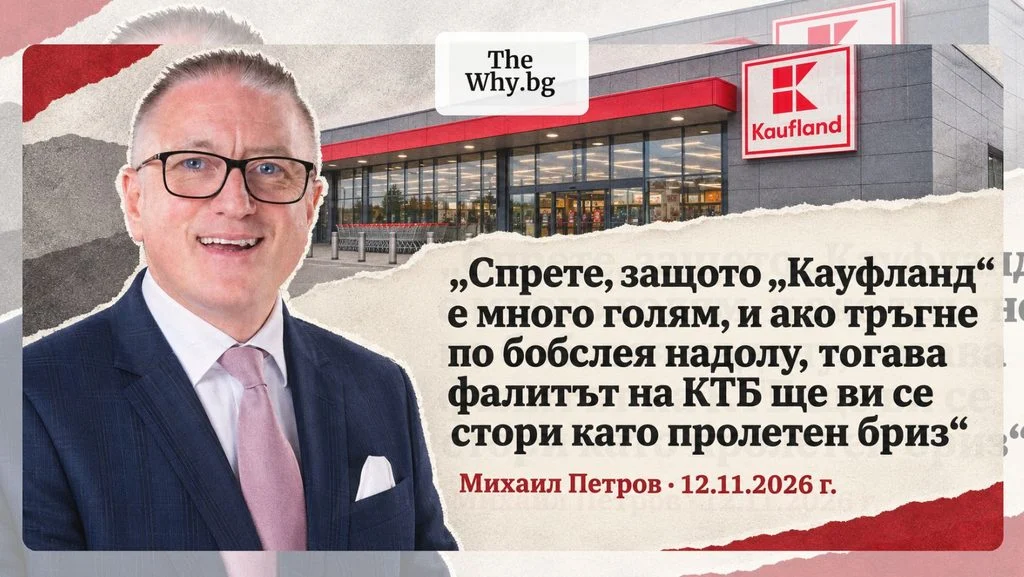
Mikhail Petrov told the state to stop. One day later, Kaufland replaced him. Petya Vladimirova is taking over the chain, along with the dispute over EUR 75.65 million, 8,800 employees and the price Bulgarian producers pay to reach the shelves.
On Thursday, November 12, Mikhail Petrov warned that if Kaufland went under, the collapse of Corporate Commercial Bank would look like a “spring breeze”. On Friday evening, the company announced that he was leaving. Kaufland Management Board Chairman Frank Schumann apologized to Bulgarian customers, institutions and the public. Petya Vladimirova took the helm of the Bulgarian company.
Petrov referred to the chain’s loans, its suppliers and the people who work in its stores and warehouses. All of them have reason to be interested in how the company has been managed. The intriguing question is who was supposed to reassure whom. While the director was explaining to Bulgaria how much it stood to lose, Kaufland’s chairman had to explain to Bulgaria why the director was speaking that way.
They apologized for Corporate Commercial Bank. The company itself spoke about the EUR 200 million
On November 9, four days before the change, Kaufland Bulgaria published a written position. In it, the company disputed the findings of the Commission for Protection of Competition (CPC) and announced that it would reconsider planned investments of EUR 200 million over the next three years. The company also said it would recommend that its parent company, Schwarz Group, review its own plans for Bulgaria.
On November 13 Frank Schumann specified exactly what the group was distancing itself from: Petrov’s tone and his historical comparisons. In the same statement, the chain confirmed that it disputes the allegations of unfair practices. It contained no decision on the fate of the planned EUR 200 million.
These two dates draw a line under the convenient explanation that one man got carried away in front of a microphone. Petrov is responsible for the comparison with Corporate Commercial Bank. But the investments first appeared as an argument on Monday, with the company’s name at the top. A director can be replaced with a single statement. Monday’s position has a separate author: Kaufland Bulgaria.
One director left. The contracts have a longer history
The CPC opened the proceedings in May 2026. Kaufland announced Petrov as Ivan Chernev’s successor in September. By the time the new director took over management, the review of the contractual relations with producers was already under way. This is an important detail for Petrov’s critics as well. His words are his own. The company is responsible for the practices on which the regulator is ruling. The decision to open the proceedings and the announcement of the appointment in September.
On November 9 the CPC announced three pecuniary sanctions totaling EUR 75,653,706. According to the commission, the chain demanded lower supply prices by using its stronger position. It improperly deducted amounts for its own services from sums owed to suppliers. And when producers requested higher prices, it created unjustified obstacles and delayed negotiations. Kaufland rejects these findings. The decision may be appealed before the Sofia District Administrative Court.
For the customer, the promotion is visible on the label. For the producer, it can appear as a deduction. A fruit and vegetable supplier told BNT that during promotions at some chains, the discount is borne entirely by him. He also described contracts under which he owes an additional discount based on turnover. BNT kept his name secret. He spoke about his experience with several chains without indicating which contract was with Kaufland. Even so, he explains the economics of the yellow price tag better than any brochure. Someone pays the difference. The buyer rarely sees who.
Why did the CPC reach EUR 75.65 million?
On November 14, the CPC’s deputy chairman Radomir Cholakov gave the regulator’s explanation. In his words, previous sanctions had proved insufficient to change the chain’s behavior. The first of the three cases cited by the commission ended with a CPC decision in 2020, finally upheld by the Supreme Administrative Court in 2023. The separate 2025 decision has been appealed. Regarding the new sanctions, the commission will have to defend both the evidence and their amount in court proceedings.
Kaufland has an argument that deserves more attention than the former director’s bobsled analogy. The European Commission does indeed report EUR 41.9 million in fines in 754 cases for the period 2022-2024. The Bulgarian decision against a single company exceeds that entire total. The reader has every right to ask the CPC for a detailed breakdown of the calculation. At the same time, the total for three reporting years does not determine the permissible sanction in a specific subsequent case. What matters is the gravity, duration and recurrence of the established violation.
There is an interesting detail outside the selected three-year period. Back in 2020, the Polish regulator sanctioned the owner of the Biedronka chain for discounts requested from suppliers after delivery, without their amount having been agreed in advance. In 2024, a Polish court upheld the violation and reduced the sanction. This is a separate case under Polish law. Its useful lesson is that it shows how a court can both accept the regulator’s findings and adjust the price it put on them.
Petya Vladimirova also inherits a question from the checkout
The new head has been with the group since August 2007, has worked in sales and network expansion, and until now has been a member of the management board. She knows the company from the inside. The first specific question to her was asked even before she took office. After Petrov included 8,800 employees in his warning, the Confederation of Independent Trade Unions in Bulgaria called for a public guarantee, that the sanction would not lead to layoffs, limits on pay or deteriorating working conditions.
In Friday’s letter, Kaufland confirmed its responsibility as an employer. The Confederation of Independent Trade Unions in Bulgaria asked for something far more specific. The person who takes a place at the checkout on Monday would like to know what will happen to their job and salary. It is difficult to be one of the 8,800 when the director needs an argument, and to receive only a general assurance when it is your turn to ask.
So… Who will pay…?
Over the weekend, a dispute emerged that matters more to the family budget than the fate of one director. On November 14, CPC member Zhelyo Boychev said on Bulgaria ON AIR, citing the commission’s analysis, that the economic benefit was shifting to the retailer at the producer’s expense. That same day, former agriculture minister Ivan Hristanov warned on NOVA NEWS that the chain could pass part of the cost on to customers through higher prices or to suppliers through new discounts. This is Hristanov’s forecast. Prices and contracts after the decision will be needed to verify it.
On November 15, the chairwoman of the Commission for Consumer Protection Maya Manolova supported the amount of the sanction and said that both producers and customers suffer from unfair practices. Meanwhile, a call for a consumer boycott was circulated on Facebook from November 16 to 22. As of Sunday, November 15, this is an announced initiative. Its actual participation and impact on sales can only be discussed after it begins.
Kaufland needed just one day to decide who would hold the microphone. The more interesting answer will come in the next negotiations with a supplier who wants to raise its price. How long will it wait? What will be deducted from it? And how much of what was agreed will ultimately enter its account? An apology for Corporate Commercial Bank does not pay the producer’s invoice…
Comments