
Chickens dropped out of the production process!
Hens have dropped out of the production process!
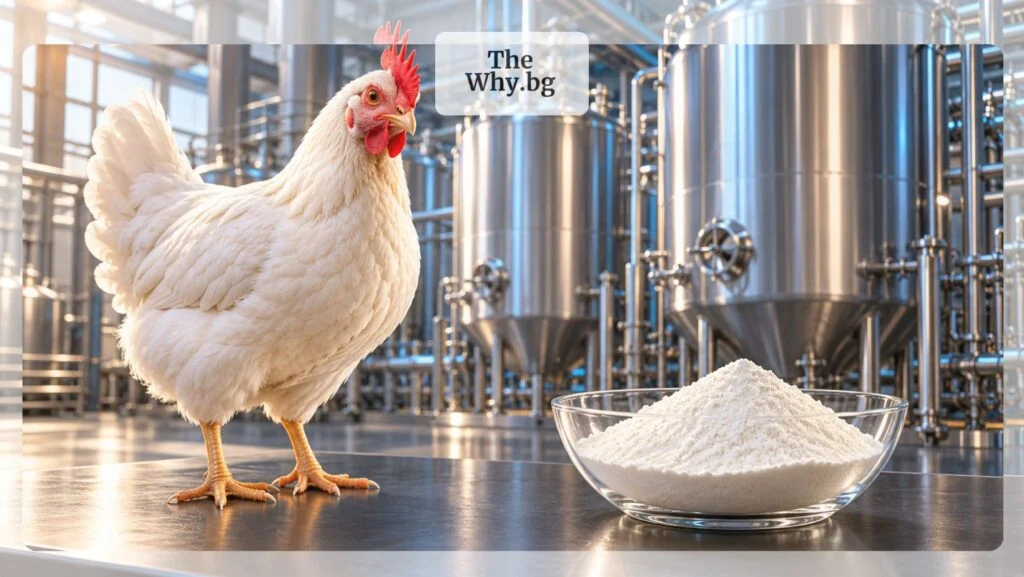
Egg protein produced without raising hens is now available. Bulgaria is part of its industrial history, while the details behind the words “vegan” and “approved” deserve far more attention than the advertising label.
For the producers of OvoPro the hen turns out to be an unnecessary intermediary. The needed egg protein can be produced by yeast, purified and packaged as a powder. It then goes into recipes for baked goods, desserts and other foods. There is no henhouse, no laying, and no shell to crack.
And then comes the first surprise: the product can be vegan and still trigger an allergic reaction to eggs. This warning is published quite openly on the Healthier Comforts page, which offers a consumer-sized package containing protein from the US company The EVERY Company. “Animal-free” describes the production. The egg allergen remains.
The second surprise is geographical. Part of this production story is unfolding in Bulgaria.
Yeast takes over the job
At the heart of OvoPro is ovalbumin, the main protein in egg white. It is precisely certain properties of this protein that interest the food industry: its ability to form foam, bind ingredients and provide structure. For these tasks, the whole egg is not always necessary.
According to EVERY’s description production begins with the genetic instructions for the desired protein. They are introduced into yeast, which produces it in fermentation vessels. Separation, purification and drying follow. The result is a powder intended to perform a specific function in food.
The documents from the FDA identify the genetically modified yeast Komagataella phaffii. According to the data submitted, the production organism is not found in the final product. The technology does not grow chicken cells or assemble whole eggs. The popular term “lab-grown eggs” lumps together under one label things that consumers have reason to distinguish.
The Bulgarian connection leads to Biovet
On June 15, 2026, EVERY announced a fourfold expansion of its production capacity through Huvepharma. The statement cited the fermentation infrastructure of Biovet AD in Bulgaria. The company describes operations on an industrial scale and regular deliveries in ton quantities.
Speaking to Green Queen, EVERY co-founder Arturo Elizondo added an even more specific detail: as of the 2026 interview, production with Huvepharma in Bulgaria had been ongoing for three years. The expansion is taking place at the same facility. According to him, OvoPro was one of several products made there, and the facilities are being redirected toward EVERY.
Thus Bulgaria turns out to be involved in a business, one we might easily assume is a distant American experiment. Its role is entirely material: facilities, industrial expertise and production. While people online argue over whether such a protein even exists, its supplier is talking about increasing volumes.
The Walmart package is real. The customer list is another matter
On Walmart.com there is a product page for Animal-Free Egg White Protein Powder by Healthier Comforts. The seller is Healthier Comforts, while the order is fulfilled by Walmart. This is a verifiable listing for protein powder. It does not prove that eggs in cartons have been replaced, nor that the package is available in every physical store.
The more interesting part of the business lies behind ready-made foods. EVERY sells ingredients to other manufacturers. In its statement about the consumer-sized package the company says that OvoPro is also used in products sold through Walmart, Target and Amazon.
Which ones exactly? In its post about entering Target EVERY leaves its partner brands unnamed, citing its commercial relationships with customers. The supplier announces its presence in major chains but does not provide a complete public list enabling buyers to trace every ready-made food.
Commercial confidentiality, however, does not override labeling requirements. The FDA requires the ingredient and the egg allergen to be identified. There is no blanket authorization to add this protein and leave it undisclosed.
EVERY recommends names such as “egg white protein (from fermentation)” and “animal-free egg white protein”. Final labeling is the responsibility of the food manufacturer. This is precisely where the tension for consumers arises: seeing “egg protein” and understanding how it was produced require different amounts of information.
“FDA-approved” sounds great. The letter says otherwise
In the FDA register for GRN 1104 there is a response dated October 17, 2023: stating “FDA has no questions”. This is not a new decision from the autumn of 2026.
The procedure is GRAS, generally recognized as safe under specified conditions of use. As the FDA explains, substances meeting this standard are exempt from the usual premarket approval for substances added to food. The manufacturer notifies the agency of its conclusion and submits the grounds for it.
In the specific letter the agency raises no questions about the company’s conclusion concerning the stated uses. It also explicitly clarifies that the response does not constitute formal confirmation of GRAS status under the relevant procedure. There is a review. There is no universal stamp saying “we approve lab-grown eggs” .
The telling detail is that EVERY itself uses “FDA-approved ingredients” in its corporate publication. Simplification, therefore, is not the exclusive preserve of panic-driven videos. It is also present in the manufacturer’s promotional narrative.
For readers, the distinction is significant: marketing language creates an impression of unequivocal certainty, while the document sets specific boundaries. Those boundaries do not amount to evidence of danger; they point to the need to state precisely what was reviewed.
The hen leaves the equation. The costs remain
For the food industry, the technology’s appeal has a very practical side. EVERY presents OvoPro as an ingredient with a shelf life of up to 24 months that requires neither refrigerated transport nor cold storage. This is an offer of more convenient supply and production planning.
Elizondo also explains the choice of an external manufacturing partner: using existing facilities allows faster scaling than building an entirely new plant. Bulgarian infrastructure has value precisely here: the technology must produce reliably, in sufficient quantities and at acceptable costs.
The benefit to the factory, however, does not automatically determine the benefit to the buyer. A more convenient ingredient for the manufacturer does not prove a lower final price, better nutritional composition or clearer labeling. Each of these claims requires its own evidence.
Made here, but for whose plate?
The Bulgarian production connection could easily give rise to the next hasty claim: that this protein must also be present in foods from the local neighborhood store. The documents reviewed do not establish any such sale.
The US regulatory pathway does not replace the European one. For novel foods, the European Commission describes a separate procedure, after which an act authorizing market access is adopted. Production in an EU country and authorization to market a product to European consumers are different matters.
The statements reviewed about the partnership do not identify any specific European authorization for this ingredient. To prove its presence in a Bulgarian store, a product name, label and legal basis for placing it on the market would be needed. For now, the identifiable Bulgarian trail leads solely to the production facilities.
Comments