
Elon Musk: 1 billion robots will replace the entire human workforce!
In this article — choose a section
Musk predicts 1 billion robots by 2036. Who will receive the money?
One billion humanoid robots, massive production and a future in which machines take on more and more work. Elon Musk's prediction has a specific source.
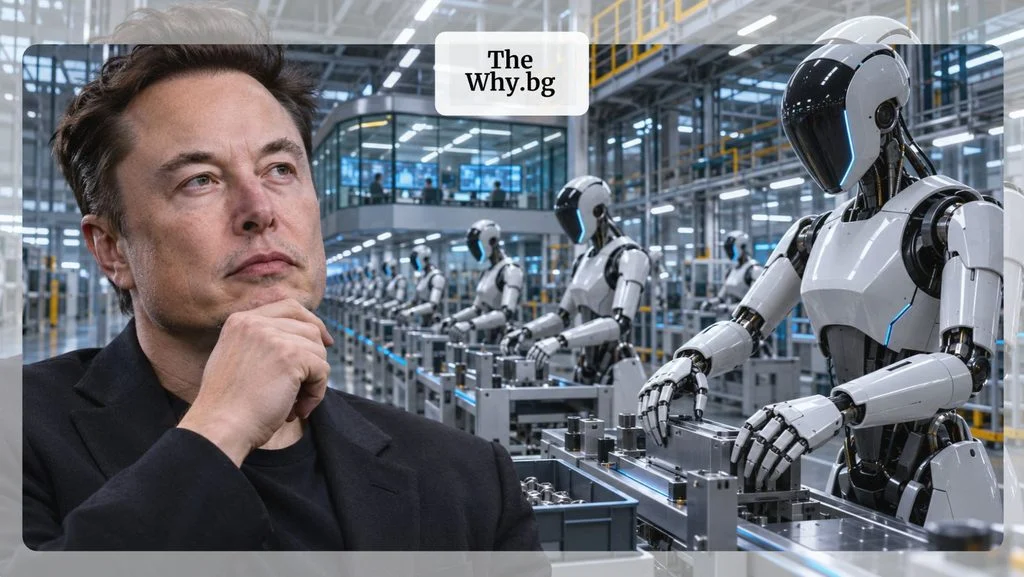
On September 1, 2026, Elon Musk makes a prediction, which deserves attention beyond technology conferences. In a conversation at the G20 meeting of innovation ministers, he predicts at least 1 billion humanoid robots in ten years. Each, he says, will have approximately five times the productivity of a human. Their combined output would exceed that produced by all of humanity.
This is indeed present in the video recording and transcript published by Reuters. The timeframe leads approximately to 2036. We are talking about a prediction by an entrepreneur developing such machines, not an established result or an international plan to eliminate jobs.
For people who live on a salary, the most important part begins after the impressive number. If machines produce more and more, through what channel will the wealth created reach households?
One billion robots does not automatically mean zero workers
Musk’s logic involves accelerating production when robots begin participating in the production of other robots. In this way, he believes, an initially slow process could develop into very rapid expansion. This is the basis of his prediction about the scale.
That, however, does not mean that every profession will disappear on a particular date. Production, employment and pay measure different things. A machine may take over some of an employee’s tasks, enable a team to produce more or make a particular position redundant. Which of these outcomes will occur also depends on the employer’s decisions.
Even technical feasibility does not by itself determine when replacement will occur. For a company, it matters whether automation works reliably enough, how much implementation costs and who is responsible in the event of an error. A demonstration in front of a camera and everyday work are different tests.
Instagram adds a calendar that looks suspiciously orderly
In the post by biz_thoughts the future is divided by year: digital work is taken over by AI in 2027, high income arrives later, and work becomes a matter of choice in 2035.
This arrangement creates the impression of a ready-made schedule. The G20 recording does not establish the entire calendar as a single prediction. Even less does it prove that a particular year will simultaneously bring technological readiness, mass adoption and income for every person affected.
There is also important context. After the warnings about jobs, he moves on to propose building automated Instagram pages. He ends by inviting readers to send a direct message to learn more. This is an advertising message that uses the predictions as the beginning of its narrative.
One-quarter of employment is exposed to change. This is not a list of layoffs
A more precise picture is offered by the study by the International Labour Organization and NASK from May 2025. According to it, around one-quarter of global employment falls within occupations with some degree of potential exposure to generative artificial intelligence.
The authors explicitly distinguish this exposure from actual job loss. The assessment examines tasks and opportunities for automation. It does not count future unemployed people. Changes to occupations are identified as a more likely overall outcome than their complete elimination.
This distinction does not eliminate the risk to the individual. If a given activity begins to be performed more quickly, an employer may expand the business, reduce the team or increase the workload. Technology provides an opportunity, while the management decision determines how it will be used.
There is also a limit to the comparison. The ILO study examines generative AI. It is not a prediction about 1 billion physical robots and does not confirm Musk’s timeframe.
The robot works. The owner receives the revenue
It is possible for the economy to produce more while some people lose their primary income. There is no contradiction: total production does not show how the revenue from it is distributed.
An IMF working paper from April 2025 examines precisely this mechanism. The model assumes that AI can affect high-paid professions and, under certain conditions, reduce differences between labor incomes. At the same time, higher returns on capital may increase wealth inequality. This is a model-based study, not a measurement of an inevitable future.
The practical meaning can be seen through a hypothetical example. Two people lose the same amount of income because of automation. One has a significant stake in the profitable business, while the other relies solely on their labor. For the first, the loss may be offset by income from ownership. For the second, no such compensation arises automatically.
That is why the promise of universal prosperity also requires an explanation of distribution. Lower prices, higher wages, shorter working hours, profit-sharing and public payments are different possible channels. None of them is automatically activated when a robot is delivered.
What does Tesla’s report say?
Musk has a direct business interest in the development of humanoid robotics: Tesla is developing Optimus. This does not disprove his prediction, but it is important context when assessing the confidence and promises involved.
In Tesla’s official report for the third quarter of 2026 the company says that production of Optimus has begun in Fremont. It also says that the hardware and production process continue to be refined.
This is concrete progress that can be tracked. Evidence of the next steps will consist of quantities produced, reliable operation and actual use, indicators distinct from the optimism of the presentation.
In its production capacity table, Tesla notes that Optimus in California is in the initial production ramp-up, while the project in Texas is under construction. No numerical annual capacity for the robots is specified for either site.
Comments