New fines system causes gridlock at Tabanovce: drivers wait for hours
Kilometer-long queues between North Macedonia and Serbia

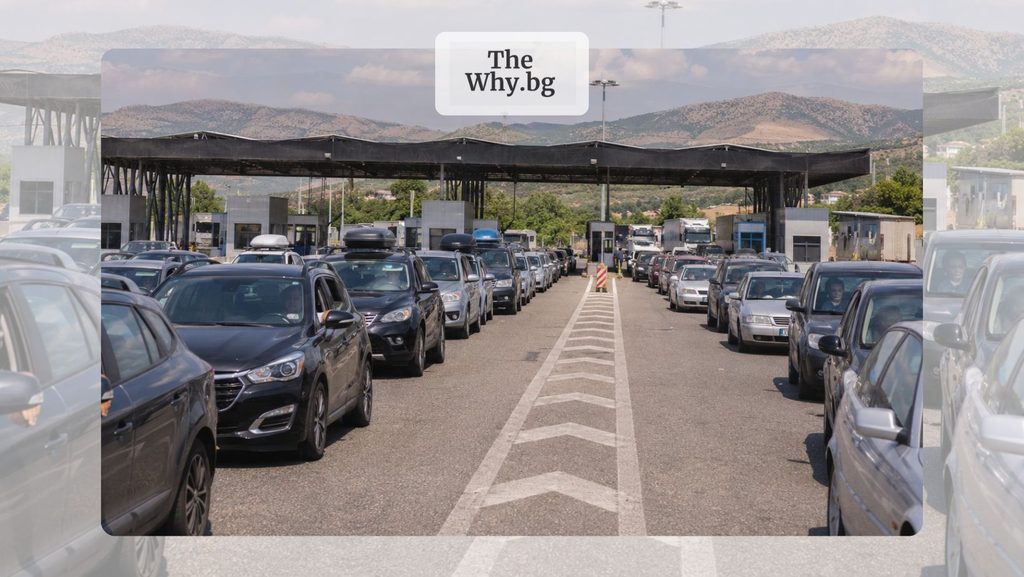
New fine system clogs Tabanovce: drivers wait for hours
Как система, създадена да автоматизира контрола, успя да добави часове към преминаването на една от най-важните граници по Коридор X? И защо шофьори без нарушение също попадат в колоната? Северна Македония започна да събира санкциите на чуждестранните водачи на границата – и първият сериозен тест дойде насред августовския трафик.
Kilometre-long queues between North Macedonia and Serbia
Kilometre-long queues and hours-long waits have formed at the border crossing between North Macedonia and Serbia on the Tabanovce-Presevo route. This time, the reason is not only the traditional August traffic to and from Greece, but also the new mechanism for sanctioning foreign drivers caught by cameras in North Macedonia’s Safe City system.
This is precisely where the paradox lies. North Macedonia has automated the detection of violations, but part of the administrative burden is emerging in the least suitable place, at the border itself.
The rule is essentially difficult to dispute: foreign registration should no longer be a way for a fine to simply disappear once the driver leaves the country. The problem is the capacity with which the new regime is being implemented amid enormous summer traffic.
Safe City now monitors more than just Macedonian licence plates
The Safe City system officially began operating on February 1, 2026 According to North Macedonia’s Interior Ministry, the smart cameras automatically detect violations, and already in the first weeks a significant number of the registered vehicles had foreign licence plates.
On February 24, for example, the system recorded 526 violations, of which 84 were committed by drivers of vehicles with foreign registration plates. The main violation detected is speeding.
For a long time, however, there was one significant gap: the camera could identify a foreign vehicle and document the violation, but serving the notice and collecting the fine from a driver who would be out of the country just a few hours later was a far more difficult task.
In July, Interior Minister Pance Toshkovski announced that this would change and that the regime would also cover foreign nationals travelling in transit. The ministry subsequently said that actual implementation would begin at Tabanovce, after which it was to be expanded to the other border crossings.
The camera records you on the road, the fine awaits you at the exit
The mechanism is relatively simple.
When a vehicle with foreign registration is linked to a violation, the information remains in the system. When leaving North Macedonia, the driver may be notified of the violation, receive the relevant document and payment order, and be offered the opportunity to pay. In certain cases, referral to a competent court under an expedited procedure is also предусмотрено.
For violations that allow voluntary payment, North Macedonia’s Interior Ministry also cites an incentive: if payment is made within eight days, half of the निर्धारित amount is due. More serious violations may also result in a driving ban.
In other words, the idea is not for border officers to start looking for who was speeding. The camera has already done that.
The border becomes the place where the administrative process meets the specific foreign driver.
The problem: a border designed to save time creates another queue
This is precisely where the system comes into conflict with another long-standing policy of Serbia and North Macedonia.
Presevo-Tabanovce is a joint border crossing since 2019, established with the aim of combining checks and shortening waiting times. The official agreement provides for joint control by the services of the two countries.
In July 2025, the procedure was further streamlined so that travellers would stop only once and be checked by the border police of the country they were entering. According to data cited at the time by Serbia’s public broadcaster RTS, around 90% of passengers between Serbia and North Macedonia.
Now another operation has been added to this highly streamlined arrangement: detecting, serving and, if necessary, settling an accumulated fine.
And if the additional procedure does not have sufficient dedicated capacity, the result is predictable: the time saved by ‘one stop’ may be lost at the next administrative step.
The problem is not that violators pay
This distinction is important.
There is no reasonable reason for a driver with foreign registration to be effectively exempt from a fine simply because they will leave the country in two hours. Such a system would penalize locals while leaving transit traffic in a privileged position. The problem begins when collecting fines delays everyone else.
Today’s queues raise a completely different question for the authorities in Skopje: does the system have sufficient administrative and technical capacity to process violations without turning all traffic into part of the procedure?
This is the real test for Safe City. A camera that identifies a licence plate and records a violation represents only half of digitization. The other half is for the subsequent procedure to be fast enough that automation does not end in a queue in front of a service window.
August is the worst time for a weakness in the system
Tabanovce-Presevo is one of the key crossings on Corridor X and a major land route between Central Europe, Serbia, North Macedonia and Greece.
Just five days before the current problem, RTS reported that around 46,000 people in both directionshad passed through Presevo in 24 hours. On August 15, the wait to enter Serbia was already around an hour even without the current effect of the new procedure. At such volumes, even a relatively small amount of additional processing time per vehicle can multiply into kilometres of queues.
Therefore, the current situation does not prove that automatic fines are a bad idea. It proves something far more practical: a well-functioning enforcement system can create a poorly functioning border process if the two are not designed together.
What does this mean for Bulgarian drivers?
For Bulgaria, this is not merely an intriguing Balkan story.
Every vehicle with Bulgarian registration in North Macedonia is a foreign-registered vehicle. This means that drivers using the country on Corridor VIII, Corridor X or continuing to Serbia must accept that automated enforcement may affect them as well.
The publicly confirmed violations detected by the system include speeding, running a red light and driving an unregistered vehicle.
It would not be accurate, however, to claim that as of August 20 exactly the same procedure is already operating at every Macedonian border crossing. The announced model began at Tabanovce, and the Interior Ministry said that expansion to the other borders was forthcoming, without at that time setting a precise date for each of them.
From ‘One Stop’ to one more stop
The story of Tabanovce-Presevo in recent years is almost a laboratory example of the Balkans’ struggle with borders.
First, the two countries combined their checks. Then they moved to a single stop. Now cameras allow violations to be detected without a police officer on the road. Each individual step should save time. But in August, the end result is a queue.
This is not an argument against enforcement, and even less against paying legally imposed fines. It is a question of whether the digital state has completed the process fully, or has simply moved the waiting from the road to the border.